Fragile dependency
Screenshot → exact source → useful card
A private, deleted, cropped, or poorly indexed post breaks the entire chain before the user receives value.
Internal feasibility lab · 31 July 2026
Forty-five real-world screenshots, rendered as the product would show them. Compare screenshot-only capture with source verification, enriched descriptions, and strictly curated related resources.
Product decision
WeChat and Xiaohongshu screenshots rarely expose durable source identity. Search can still recover useful, grounded context, so the better product tradeoff is an improved card with carefully admitted related evidence.
| Experiment | Result | Meaning |
|---|---|---|
| Sogou Weixin | 0 / 5 sources | Temporary result URLs and weak title identity could not establish a canonical article. |
| Self-hosted SearXNG | 0 / 5 sources | Owning the metasearch layer did not create coverage in the upstream indexes. |
| Bocha domain search | 45 candidates, 0 commits | Finding the right platform domain is not the same as finding the screenshot's source. |
| Related-evidence review | 22 / 29 useful | The same screenshot text often retrieved context worth showing, despite finding zero original URLs. |
| Blind Exa comparison | 28 / 29 useful | Exa was the strongest retrieval prototype; Bocha remained occasional corroboration. |
| Fresh product canary | 12 / 15 shown | Twelve cards earned one related resource, three correctly abstained, and no second link added enough value. |
Fragile dependency
A private, deleted, cropped, or poorly indexed post breaks the entire chain before the user receives value.
Recommended product path
The screenshot remains useful immediately. Search adds context only when a strict quality policy admits it.
This is a fallback, not a surrender. Visible URLs, QR codes, user-supplied links, and existing stored URLs remain canonical. Source discovery can continue as a separate precision-first capability that is allowed to abstain.
One reusable capture package owns the contracts and modules. Search providers and the model judge are replaceable adapters. Deterministic code makes the final admission decision.
Build one production package, @snapaction/capture, and one lab tool. Develop in an isolated feature worktree from current develop, integrate agent work in supervised waves, and keep production activation separate from the first implementation PR.
Screenshot-derived fields only
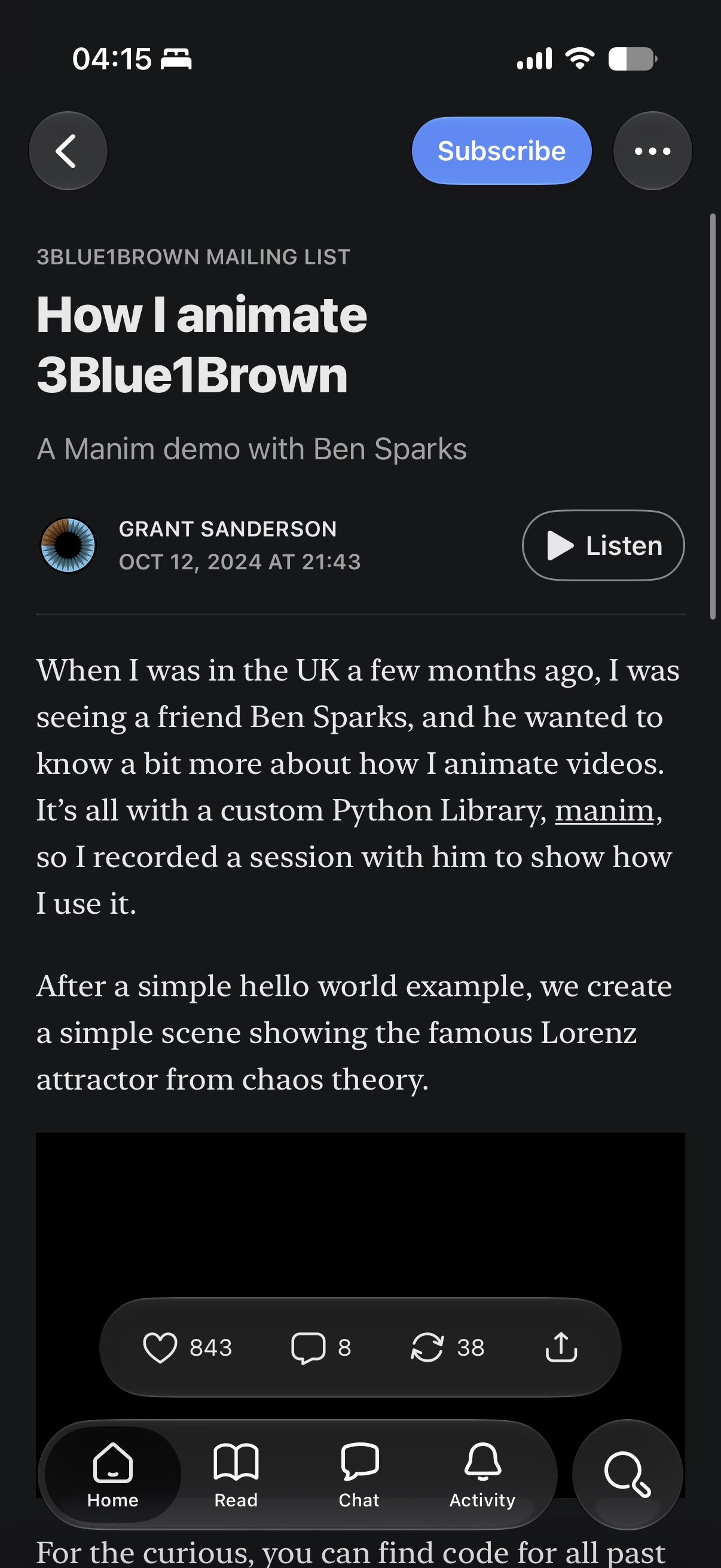
Grant Sanderson 演示了他如何使用 Manim(一个自定义 Python 库)来制作动画视频,包括与 Ben Sparks 的演示会议。
Verified source and policy-admitted context only
Grant Sanderson 在这篇随笔中分享了他制作 3Blue1Brown 动画的技术细节,并附带了与 Ben Sparks 录制的演示会议视频。他详细介绍了如何使用自定义 Python 库 Manim 构建动画场景(如洛伦兹吸引子),并提供了相关代码库的访问路径。